

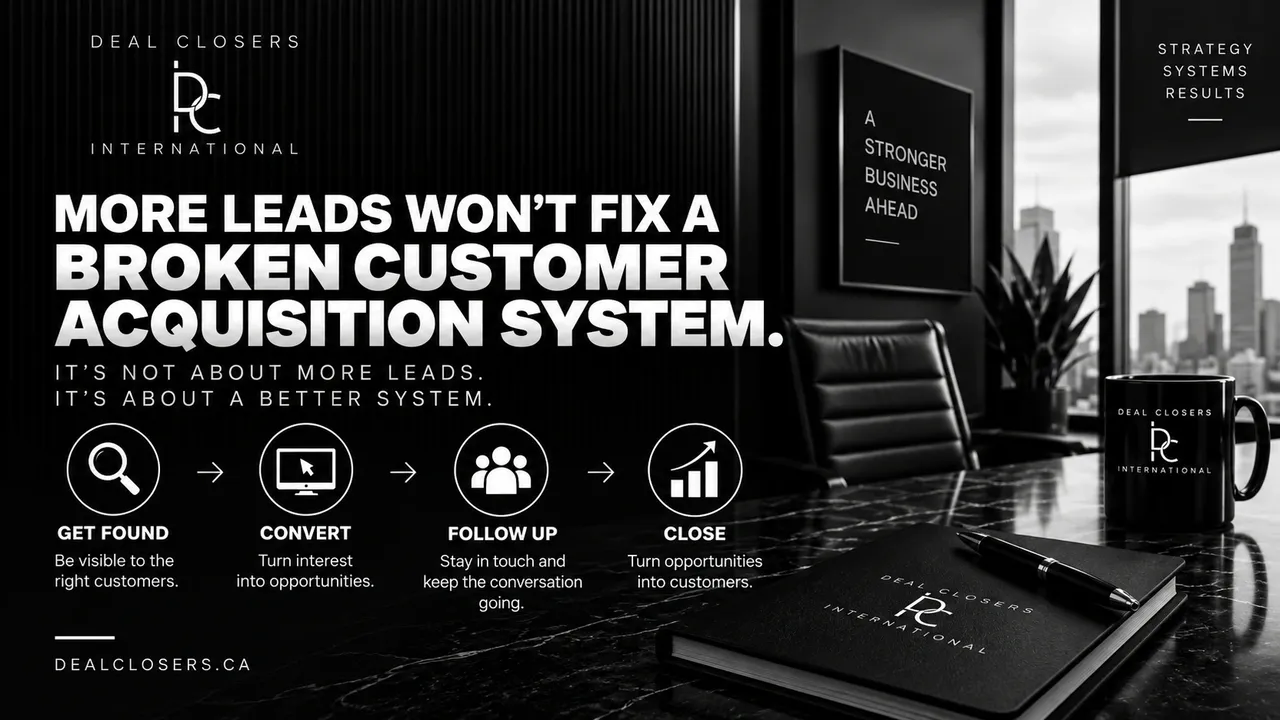
When a business wants to grow, one of the first answers is usually simple: we need more leads.
But getting more leads won’t necessarily improve results if the underlying customer acquisition process is losing opportunities before they become paying customers.
More website traffic. More Google visibility. More advertising. More phone calls.
Sometimes that’s exactly what the business needs.
But sometimes generating more leads simply sends more potential customers into a system that’s already losing them.
Before spending more money trying to attract new customers, it’s worth asking a different question:
What happens to the opportunities you’re already getting?
Why Your Customer Acquisition Process Matters More Than Lead Volume
Getting someone’s attention is only the beginning.
A potential customer might discover your business through Google, an advertisement, social media or a referral. But several things still have to happen before that person becomes a customer.
They need to find the right information.
They need to trust your business.
They need an obvious way to contact you.
Someone needs to respond.
The opportunity needs to be followed up.
And ultimately, someone needs to close the sale.
A weakness anywhere in that process can cost you customers.
That’s why we look at customer acquisition as four connected stages:
Get Found → Convert → Follow Up → Close
Improving one stage while ignoring the others can produce disappointing results.
1. Get Found
Before someone can become a customer, they need to find you.
That can happen through Google Search, Google Maps, paid advertising, social media, referrals and increasingly through AI-powered search and recommendation tools.
If competitors consistently appear when potential customers are searching and your business doesn’t, you have a visibility problem.
In that situation, generating more opportunities really may start with improving how you’re found.
But visibility alone isn’t enough.
2. Convert
Imagine you’re already getting hundreds of people to your website every month.
What happens next?
Potential customers are quickly trying to determine whether you can solve their problem, whether they trust you and what they should do next.
Confusing messaging, weak calls to action, poor mobile experiences, missing credibility signals or unnecessarily complicated contact forms can all cause visitors to leave.
If that’s happening, buying additional traffic doesn’t solve the underlying problem.
You’re simply paying to send more people into a website that isn’t converting effectively.
3. Follow Up
This is one of the easiest places for revenue to disappear.
Someone requests a quote.
Calls and doesn’t reach anyone.
Fills out a contact form.
Asks a question.
Then nothing happens quickly enough—or nobody follows up again.
Businesses spend significant amounts of money generating inquiries and then allow perfectly good opportunities to disappear because there isn’t a consistent follow-up process.
CRM systems and automation can help, but technology isn’t the objective.
The objective is simple:
Make sure valuable opportunities don’t get forgotten.
4. Close
Eventually, customer acquisition becomes a sales problem.
You can have excellent Google visibility, a great website and strong lead follow-up and still struggle if those opportunities aren’t being converted into customers.
That can mean looking at qualification, appointment setting, sales conversations, scripts, objection handling and the overall process used to move an interested prospect toward a decision.
The entire system matters.
Find the Leak Before Spending More Money
Consider a business generating 100 inquiries each month. If those inquiries produce 40 proposals and 10 customers, the business has a 10% inquiry-to-customer conversion rate. Improving that rate to 15% would generate five additional customers from the same number of inquiries, without increasing lead volume.
This is why measuring cost per lead alone isn’t enough. Businesses also need to understand their cost to acquire a customer, the value of that customer, and where opportunities are being lost between the first inquiry and the final sale.
10 Questions to Identify Where You’re Losing Customers
Before increasing your marketing budget, ask:
- How many legitimate inquiries are we generating each month?
- Which marketing channels produce those inquiries?
- How quickly do we respond to new inquiries?
- How many inquiries become qualified sales opportunities?
- How many opportunities receive an estimate or proposal?
- What happens after a proposal is sent?
- Does every active opportunity have a scheduled follow-up?
- What happens to prospects who aren’t ready to buy immediately?
- What percentage of inquiries become paying customers?
- What is the average value of a new customer?
You don’t need a complicated dashboard with dozens of metrics. You need enough information to identify the biggest constraint in your customer acquisition system and determine what to improve first.
This is why the answer to slow growth isn’t automatically:
“Spend more on advertising.”
“Do more SEO.”
“Build another website.”
“Buy a CRM.”
Every one of those could be the correct investment.
But they could also be the wrong investment if the actual bottleneck is somewhere else.
Before deciding what to buy, determine where you’re losing customers.
At Deal Closers International, that’s exactly what our Free Customer Acquisition Review is designed to uncover.
We look at how customers find your business, what happens when they reach you, how opportunities are captured and what happens after someone becomes a lead.
Then we identify the gaps we believe deserve attention first.
Because sometimes the fastest way to generate more customers isn’t generating more leads.
It’s doing a better job with the opportunities you already have.